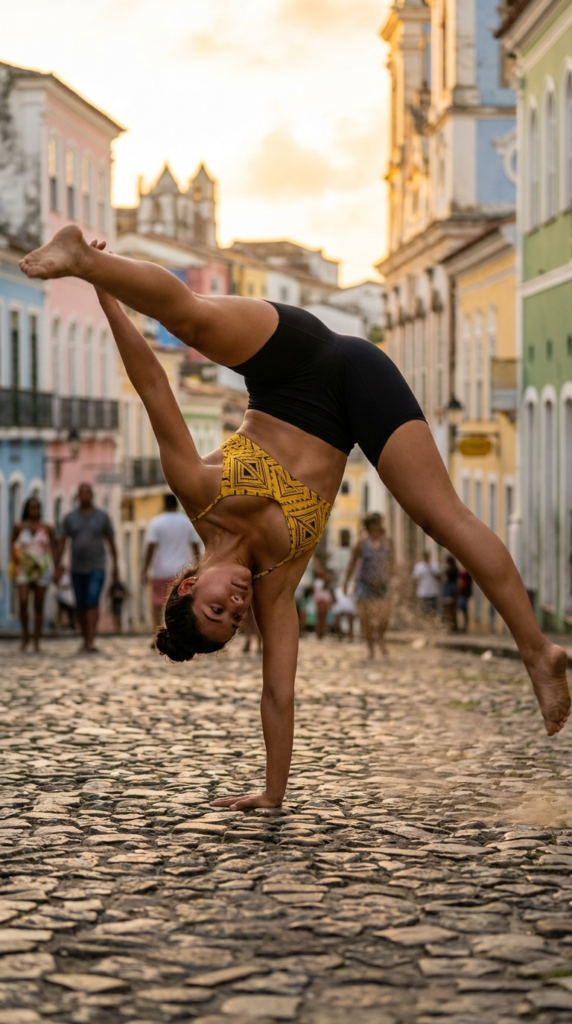
The capoeirista's body becomes a perpetual arc across the sand, legs scissoring through air in meia lua sequences that blur speed with balletic control. Each spin anchors briefly on calloused hands before launching into the next rotation, the discipline demanding simultaneous strength and fluidity—a martial conversation conducted entirely through motion. The rhythm arrives before the body completes its geometry, berimbau strings providing the metronome that transforms combat into something closer to trance.
Behind the performance, Barceloneta's pastel-colored buildings frame the Atlantic light as it turns honey-gold across the beach. The sun sits low enough to cast the athlete's shadow long and deliberate against pale sand, each extension of the leg stretching that silhouette into something almost architectural. The asphalt apron where the routine concludes—worn smooth by centuries of footsteps—catches that same amber glow, making the final handstand balance feel suspended between earth and sky. In those closing seconds, as the capoeirista's body inverts one last time, the crowd's intake of breath mingles with the distant creak of moored boats and the berimbau's fading echo.